Showing posts with label Plants. Show all posts

Sunday, April 1, 2018

Lyre-leaf Sage (Salvia lyrata)

Lyreleaf sage, Wild Sage, Cancer-weed (Salvia lyrata), is a herbaceous perennial in the family Lamiaceae that is native to the United States, distributed from Connecticut west to Missouri, and in the south from Florida west to Texas.

It was described and named by Carl Linnaeus in 1753.

Typically found roadside and in open fields. Though it flowers almost whole year, profuse flowering is seen during April to June. Sometimes grown in gardens though it can quickly become weed. Native Americans used tea of whole plants for cough and cold. Common name Cancer-weed is due to misconception of the plant being used for cancer treatment.


References:

Tuesday, March 10, 2015

Flame of the Forest (Butea monosperma)

Flame-of-the-forest (Butea monosperma) is a species of Butea which is member of Fabaceae, is native to tropical and sub-tropical parts of the Indian Subcontinent and Southeast Asia, ranging across India, Bangladesh, Nepal, Sri Lanka, Myanmar, Thailand, Laos, Cambodia, Vietnam, Malaysia, and western Indonesia. Common names include flame-of-the-forest and bastard teak.

It is used for timber, resin, fodder, medicine, and dye. The wood is soft and durable under water, is used for well-curbs and water scoops. Spoons/Ladles made of this tree are used in various rituals to pour Ghee into the fire. Good charcoal can be obtained from it. The leaves are usually very leathery and not eaten by cattle. The leaves are used to make food plates or patravali.

If one travels in central India in the months of March or April, it is hard to miss the trees even from long distance.


References:

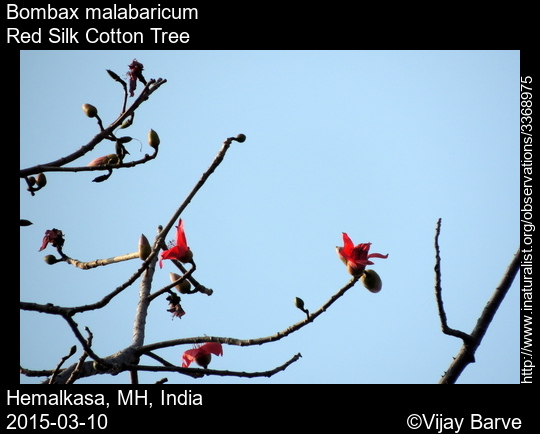
Red Silk Cotton Tree (Bombax ceiba)

Red silk-cotton tree (Bombax ceiba or Bombax malabaricum), it is sometimes known as red cotton tree; or ambiguously as silk-cotton or kapok, both of which may also refer to Ceiba pentandra. Other trees of the genus Bombax, is commonly known as cotton tree. This belongs to Malvaceae family.

Deciduous tree from Asian tropics, bears beautiful red flowers in spring before the leaves start reappearing. Dry cores of the flowers are used in Thai cuisine nam ngiao spicy noodle soup as well as kaeng khae curry. Used in Ayurveda, Siddha and Folk medicine in India.

The tree looks spectacular when it is totally leafless and full of flowers and it attracts a lot of birds and insects for food.


References:

Sunday, August 17, 2014

Slender dwarf morning-glory (Evolvulus alsinoides)


Slender dwarf morning-glory (Evolvulus alsinoides) is an herb with beautiful flowers, is a member of family Convolvulaceae. Seen in a wide range of habitats, from marshy places to wet forests to deserts. In India seen almost all over except higher Himalayas. शंखपुष्पी in Sanskrit and शंखवेल in Marathi.

Celandine Spider Flower (Cleome chelidonii)

Celandine Spider Flower (Cleome chelidonii) 'पाण तिळवण' (in Marathi) family Cleomaceae but was placed in family Capparaceae earlier. Usually seen near water. This genus has more than 250 species according to recent taxonomic studies.


Monday, December 31, 2007

Lilac tasselflower (Emilia sonchifolia)

Lilac tasselflower or Cupid's shaving brush (Emilia sonchifolia) is tropical flowring plant of sunflower family. Widespread plant in tropical regions around the world, but believed to be native of Asia (China, India, Southeast Asia) and naturalized elsewhere.

One of the Dashpushpam in Kerala. It is also used in traditional Chinese medicine as well as Vietnam.


References:

Saturday, September 8, 2007