Showing posts with label India. Show all posts

Thursday, October 13, 2022

Zebra Blue Butterflies (Leptotes)

Genus Leptotes in the butterfly family Licaenidae is group of species with intricate patterns on their underwings. Linnaeus encountered this genus and described as Papilio pirithous in 1767 in his Systema naturae. Later Scudder grouped two American species into genus Leptotes. Worldwide there are now about 25 species in this genus, distributed mainly in Afro-tropical and Neo-tropical regions, but the lone Indo-Australian species placement is a bit uncertain.

So far I met four species of these group. The first one is obviously the Indo-Australian species: Leptotes plinius or the Zebra Blue. This was in India, however it has a very wide distribution. I have interacted with this butterfly numerous times.   


Second species of the group that I have met is Leptotes cassius or the Cassius Blue. This species is distributed in Florida and Texas all the way down to South America. This butterfly can be seen around Plumbago or few other Fabaceae plants. 


The third species is Leptotes pirithous or the Lang's Short-tailed Blue, who I met in Haifa, Israel. When I saw both these species in Florida and Israel, I thought, "Oh the Indian species is here too," but then I found out that they are all actually different species which look very similar.


The fourth one I met recently in California. This is the Marine Blue (Leptotes marina) which is distributed more on western USA and Mexico. 


Thursday, June 28, 2018

Scaly-breasted Munia (Lonchura punctulata)

Scaly-breasted Munia (Lonchura punctulata) also called as Spotted Munia is fairly common bird in peninsular India. This is also a popular cage bird in pet trade and is called as Nutmeg Mannikin or Spice Finch. Also known in popular culture due to songs like "चलत मुसाफ़िर मोह लियो रे पिंजड़े वाली मुनिया". 

This Munia is distributed from India to Indonesia and has been introduced and established in Australia and Puerto Rico & Hispaniola. They feed on grass seeds and small insects. They form flocks of up to 100 individuals. 


References:

Tuesday, March 10, 2015

Flame of the Forest (Butea monosperma)

Flame-of-the-forest (Butea monosperma) is a species of Butea which is member of Fabaceae, is native to tropical and sub-tropical parts of the Indian Subcontinent and Southeast Asia, ranging across India, Bangladesh, Nepal, Sri Lanka, Myanmar, Thailand, Laos, Cambodia, Vietnam, Malaysia, and western Indonesia. Common names include flame-of-the-forest and bastard teak.

It is used for timber, resin, fodder, medicine, and dye. The wood is soft and durable under water, is used for well-curbs and water scoops. Spoons/Ladles made of this tree are used in various rituals to pour Ghee into the fire. Good charcoal can be obtained from it. The leaves are usually very leathery and not eaten by cattle. The leaves are used to make food plates or patravali.

If one travels in central India in the months of March or April, it is hard to miss the trees even from long distance.


References:

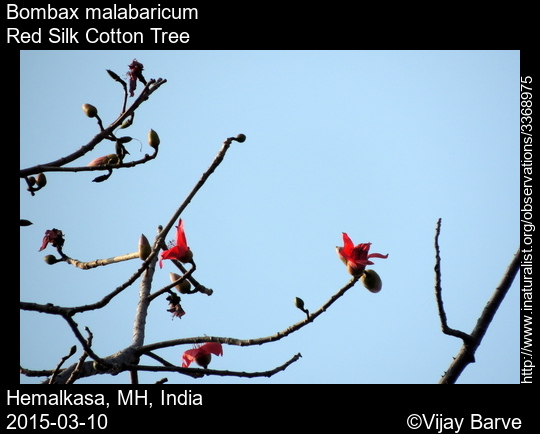
Red Silk Cotton Tree (Bombax ceiba)

Red silk-cotton tree (Bombax ceiba or Bombax malabaricum), it is sometimes known as red cotton tree; or ambiguously as silk-cotton or kapok, both of which may also refer to Ceiba pentandra. Other trees of the genus Bombax, is commonly known as cotton tree. This belongs to Malvaceae family.

Deciduous tree from Asian tropics, bears beautiful red flowers in spring before the leaves start reappearing. Dry cores of the flowers are used in Thai cuisine nam ngiao spicy noodle soup as well as kaeng khae curry. Used in Ayurveda, Siddha and Folk medicine in India.

The tree looks spectacular when it is totally leafless and full of flowers and it attracts a lot of birds and insects for food.


References:

Monday, November 17, 2014

Tanaorhinus viridiluteatus from Sikkim

I met this beautiful Tanaorhinus viridiluteatus in Gangtok, Sikkim. Initially described as Geometra viridiluteata by Walker in 1861, from Darjiling hills, Butler gave the current name in 1886. The genus Tanaorhinus is mostly an Asian genus with number species between 4 and 14 according to different authorities. This is a member of Geometridae family.

Since moth species are so numerous and moths are so under studied in India, most of the moths do not have common names. 


References:

Sunday, August 17, 2014

Slender dwarf morning-glory (Evolvulus alsinoides)


Slender dwarf morning-glory (Evolvulus alsinoides) is an herb with beautiful flowers, is a member of family Convolvulaceae. Seen in a wide range of habitats, from marshy places to wet forests to deserts. In India seen almost all over except higher Himalayas. शंखपुष्पी in Sanskrit and शंखवेल in Marathi.

Celandine Spider Flower (Cleome chelidonii)

Celandine Spider Flower (Cleome chelidonii) 'पाण तिळवण' (in Marathi) family Cleomaceae but was placed in family Capparaceae earlier. Usually seen near water. This genus has more than 250 species according to recent taxonomic studies.


Monday, July 28, 2014

Brinjal fruit and shoot borer (Leucinodes orbonalis)

Brinjal fruit and shoot borer (Leucinodes orbonalis) or Eggplant fruit and shoot borer is a small moth of the family Crambidae. It is found throughout the tropics in Asia and Africa and is a minor pest in the Americas. The larvae bore into fruits and tender shoots of Egg plants.

There are about 20 species in the genus Leucinodes. Several of them were described just a few years back, from Africa.

I met this one at my home in Bangalore.


References:

Sunday, July 7, 2013

Asian ant mantis (Odontomantis planiceps)

Asian ant mantis or grass mantis (Odontomantis planiceps) is a species of praying mantis (Order Mantodea). The young ones mimic ants to earn the name Asian ant mantis.

The reason to mimic ants is probably protection. Ants being very aggressive, moving in numbers, acidic in taste and possess stings.


The adults are green in color and grow up to an inch long. People love to keep these as pets.


Friday, July 5, 2013

Red Cotton Stainer (Dysdercus cingulatus)

Red Cotton Stainer (Dysdercus cingulatus) are true bugs (Hemiptera) of family Pyrrhocoridae. It is considered a serious pest on Cotton and several other crops, because the bugs as well and nymphs feed on flowers and bolls of cotton by sucking the juice and in the process transmitting fungus and other disease. 

This occurs from India to Australia. It feeds on variety of hosts like Cotton, Okra, Hibiscus and even some trees like Silk Cotton trees. When host plant are not available they survive on fruits or can even go hungry for days. 


Saturday, June 8, 2013

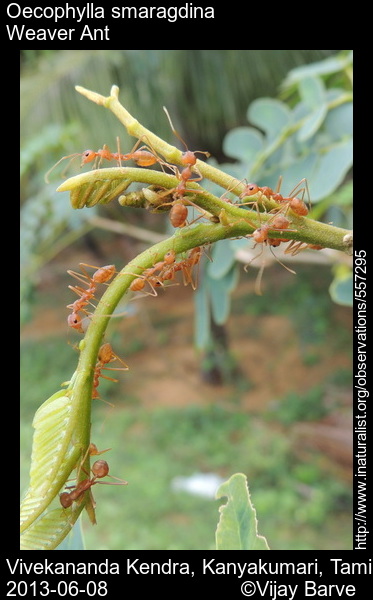
Weaver ants (Oecophylla smaragdina)

Weaver Ant (Oecophylla smaragdina) also referred as green ant, green tree ant, and orange gaster. Thies are arboreal species found in Asia and Australia. These ants build nests stitching leaves together using silk produced by ant larvae. These are eusocial insects meaning very high level social structure. The colonies could be very large consisting of several nests.