Showing posts with label 2018. Show all posts

Wednesday, November 13, 2019

Fashion Commodore (Precis pelarga)

The Fashion Commodore (Precis pelarga) belongs to the Nymphalidae family and is commonly found in the Afrotropical region. I've had the privilege of encountering this butterfly in Benin on multiple occasions. The genus Precis is native to Africa and comprises approximately 17 distinct species.

Initially, I mistook this butterfly for a Pansy (Junonia) species due to its striking resemblance. It's fascinating to note that both of my observations of the Fashion Commodore were in well-wooded areas, where these butterflies seem to thrive and find their natural habitat.


References:

Sunday, October 7, 2018

Mimicry in butterflies


Some of the Butterflies have chemical defense against certain predators. In the caterpillar stage, they consume certain plants and store the chemicals which prevent some predators to eat them. These predators, specially birds are known to remember the distaste and associated wing patterns. To take advantage of this, certain species copy the pattern to avoid the predators. This is called as Batesian Mimicry. Another group, which is also distasteful copies the pattern to make sure the predators remember the pattern, these are called Mullerian mimics.


Plain Tiger or African Monarch (Danaus chrysippus) feeds on Milkweed plants in caterpillar stage so has the required chemical defense making it a model in this mimicry.


One of the very common mimic of this model is Danaid Eggfly (Hypolimnas misippus) in which only the female mimics the Plain Tiger butterfly and male is completely different, so much so that one might think it is a different species.


Saturday, October 6, 2018

Rainbow Agama (Agama agama)

In my Benin, West Africa visit, the first reptile I encountered was this beautiful Rainbow Agama (Agama agama) also referred as Common Agama or Red Headed Agama belonging to Agamidae family. This is widely distributed in Sub Saharan Africa. There are about 40 species in this genus.

This seems to be most common and omnipresent reptile in Benin. The males have this orange head and rainbow like color patterns on the tail. The females have more grey brown coloration with intricate patterns on the head.


References:

Thursday, June 28, 2018

Scaly-breasted Munia (Lonchura punctulata)

Scaly-breasted Munia (Lonchura punctulata) also called as Spotted Munia is fairly common bird in peninsular India. This is also a popular cage bird in pet trade and is called as Nutmeg Mannikin or Spice Finch. Also known in popular culture due to songs like "चलत मुसाफ़िर मोह लियो रे पिंजड़े वाली मुनिया". 

This Munia is distributed from India to Indonesia and has been introduced and established in Australia and Puerto Rico & Hispaniola. They feed on grass seeds and small insects. They form flocks of up to 100 individuals. 


References:

Wednesday, April 11, 2018

Skiff Moth (Prolimacodes badia)

The skiff moth (Prolimacodes badia), is a moth of the Limacodidae family. It is found in Americas from Southern Canada, USA all the way up to Costa Rica and Beliz. In North America, it reaches west to southern Ontario, Missouri, Arkansas and Mississippi.

The larvae feed on the leaves of a wide variety of trees and shrubs, including birch, blueberry, cherry, chestnut, oak, poplar, willow and even poison ivy.

Specific name badia comes from the Latin "badius" (reddish-brown or bay-colored); probably refers to the color of the patches on the forewing, and skiff perhaps from the resemblance of the caterpillar to one of those small boats.


References:

Wednesday, April 4, 2018

Phaon Crescent (Phyciodes phaon)

Phaon crescent (Phyciodes phaon)  or mat plant crescent, is a species of butterfly of the family Nymphalidae, found in Florida, neighboring states, west to New Mexico and south to Cuba and the Cayman Islands where is it known as the crescent spot. Typically encountered in early spring to late fall in most of the range, and all round the year in peninsular Florida.

Genus Phyciodes commonly called as Crescents or Crescent spots, has more than 10 species mainly in North Americas.


References:

Sunday, April 1, 2018

Poey's Furrow Bee (Halictus poeyi)

Poey's Furrow Bee (Halictus poeyi) is member of family Halictidae, commonly called as sweat bees, halictid bees. Halictids display the most diverse gradation in social behavior (Michener 2007) as species can be solitary, communal, semi-social or eusocial.


Most species are polylectic, or gather floral resources from multiple plant species. There are a few oligolectic species and subgenera that feed from a single plant family.  Adult halictids eat nectar, and collect nectar and pollen for the larvae.


References

Ceraunus Blue (Hemiargus ceraunus)

Ceraunus blue (Hemiargus ceraunus) is a butterfly in the Lycaenidae family. It is found in the southwestern United States, southern Texas, Florida.

Like most Lycaenidae members, the upperside of the males is light blue with a darker narrow border. Female are dark brown, often with blue wing bases.

The larvae feed on the flowers and seedpods of various woody legumes like Cassia and Abrus. Adults feed on flower nectar.


Lyre-leaf Sage (Salvia lyrata)

Lyreleaf sage, Wild Sage, Cancer-weed (Salvia lyrata), is a herbaceous perennial in the family Lamiaceae that is native to the United States, distributed from Connecticut west to Missouri, and in the south from Florida west to Texas.

It was described and named by Carl Linnaeus in 1753.

Typically found roadside and in open fields. Though it flowers almost whole year, profuse flowering is seen during April to June. Sometimes grown in gardens though it can quickly become weed. Native Americans used tea of whole plants for cough and cold. Common name Cancer-weed is due to misconception of the plant being used for cancer treatment.


References:

Saturday, February 24, 2018

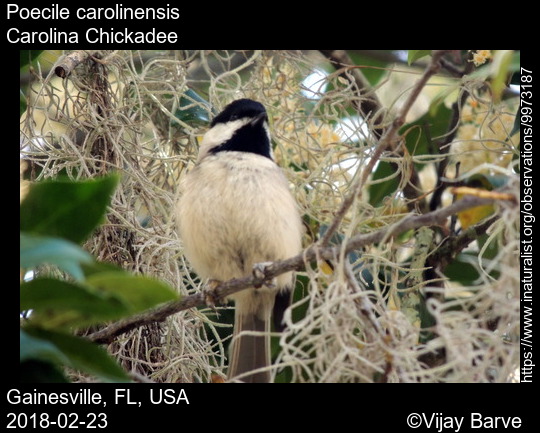
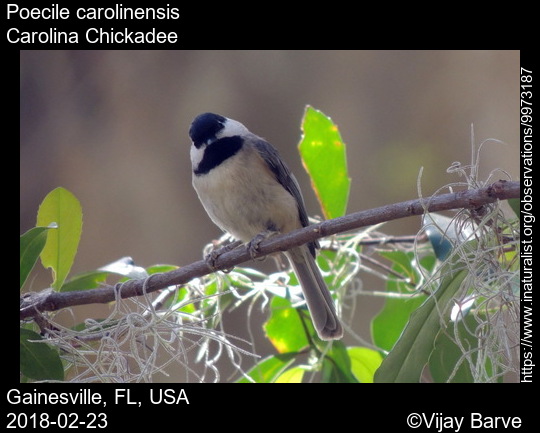
Carolina Chickadee (Poecile carolinensis)

The Carolina chickadee (Poecile carolinensis) is a small and active bird in the tit family Paridae. Earlier this was placed in the genus Parus.

I have seen different species in this family and they are always fun to watch. I have watched Great Tit in India several times.