Showing posts with label 2013. Show all posts

Thursday, October 13, 2022

Zebra Blue Butterflies (Leptotes)

Genus Leptotes in the butterfly family Licaenidae is group of species with intricate patterns on their underwings. Linnaeus encountered this genus and described as Papilio pirithous in 1767 in his Systema naturae. Later Scudder grouped two American species into genus Leptotes. Worldwide there are now about 25 species in this genus, distributed mainly in Afro-tropical and Neo-tropical regions, but the lone Indo-Australian species placement is a bit uncertain.

So far I met four species of these group. The first one is obviously the Indo-Australian species: Leptotes plinius or the Zebra Blue. This was in India, however it has a very wide distribution. I have interacted with this butterfly numerous times.   


Second species of the group that I have met is Leptotes cassius or the Cassius Blue. This species is distributed in Florida and Texas all the way down to South America. This butterfly can be seen around Plumbago or few other Fabaceae plants. 


The third species is Leptotes pirithous or the Lang's Short-tailed Blue, who I met in Haifa, Israel. When I saw both these species in Florida and Israel, I thought, "Oh the Indian species is here too," but then I found out that they are all actually different species which look very similar.


The fourth one I met recently in California. This is the Marine Blue (Leptotes marina) which is distributed more on western USA and Mexico. 


Saturday, July 29, 2017

Robber Flies (Family Asilidae)

Robber flies or assassin flies (Family Asilidae). They are powerfully built, bristly flies with a short, stout proboscis enclosing the sharp, sucking hypopharynx.

The name "robber flies" reflects their notoriously aggressive predatory habits; they feed mainly or exclusively on other insects and as a rule they wait in ambush and catch their prey in flight.

I have seen them in USA, Israel and in India.

#World RobberflyDay


References:

Monday, November 18, 2013

Red Tailed Hawks feeding on Grey Squrrel

Today morning at about 8 am while walking to the university, I noticed a Red Tailed Hawk (Buteo jamaicensis) sitting in the grass from a distance. I was curious to see what it was up to, but I was getting late for work, so I kept walking, obviously keeping an eye on the bird. I noticed it was holding something under its paw and was trying to feed on it.


Around noon, when I returned for lunch, I was surprised to see a Red Tailed Hawk on the same location. (It could have been the same bird). I rushed home to get my camera. The location was right by the sidewalk and I was worried some passer by might disturb the bird.


 I was really happy to see the bird was still there when I returned with my camera in a few minutes. But also as suspected, a person passing by noticed the bird and was trying to approach it with his cell phone camera in hands.


Next few minutes I spent observing and photographing the bird feeding on a Gray Squirrel (Sciurus carolinensis). Grey Squirrels are fairly common rodents in Easter Kansas where I observed it. They feed on tree buds and nuts. They tend to bury the nuts when they are plentiful and use them in winter when food is scarce. They use their keen sense of smelling to find them back.


It carefully looks at the food.


Lifted a piece of squirrel ... 


... and twisted on its side.


It was taking long pauses in between and checking out the vicinity.


The hawk noticed me and gave an angry look...


... and then continues enjoying the meal.


On the watch tower nearby another hawk appeared from nowhere.


The hawk continues to feast on what was left of the unfortunate squirrel. 


The Hawk took off and joined the other on on the observation tower.


Finally what was left of the squirrel was this.

Sunday, July 7, 2013

Asian ant mantis (Odontomantis planiceps)

Asian ant mantis or grass mantis (Odontomantis planiceps) is a species of praying mantis (Order Mantodea). The young ones mimic ants to earn the name Asian ant mantis.

The reason to mimic ants is probably protection. Ants being very aggressive, moving in numbers, acidic in taste and possess stings.


The adults are green in color and grow up to an inch long. People love to keep these as pets.


Friday, July 5, 2013

Red Cotton Stainer (Dysdercus cingulatus)

Red Cotton Stainer (Dysdercus cingulatus) are true bugs (Hemiptera) of family Pyrrhocoridae. It is considered a serious pest on Cotton and several other crops, because the bugs as well and nymphs feed on flowers and bolls of cotton by sucking the juice and in the process transmitting fungus and other disease. 

This occurs from India to Australia. It feeds on variety of hosts like Cotton, Okra, Hibiscus and even some trees like Silk Cotton trees. When host plant are not available they survive on fruits or can even go hungry for days. 


Saturday, June 8, 2013

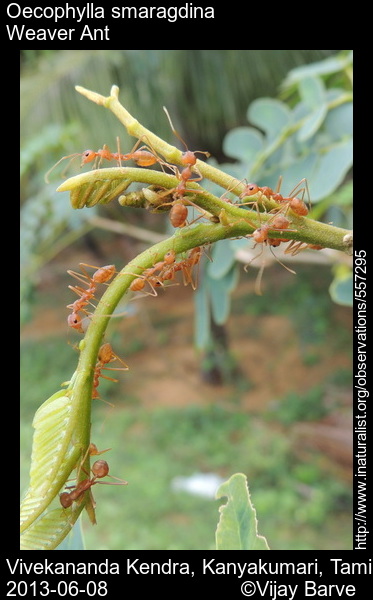
Weaver ants (Oecophylla smaragdina)

Weaver Ant (Oecophylla smaragdina) also referred as green ant, green tree ant, and orange gaster. Thies are arboreal species found in Asia and Australia. These ants build nests stitching leaves together using silk produced by ant larvae. These are eusocial insects meaning very high level social structure. The colonies could be very large consisting of several nests.