Showing posts with label Tasmania. Show all posts

Friday, October 27, 2023

Black Swan (Cygnus atratus)

The Black Swan (Cygnus atratus) is an iconic waterbird, a graceful and elegant species of swan native to southern Australia. Its striking appearance, characterized by its sleek black plumage, bright red beak, and contrasting white flight feathers, has made it a popular symbol of the country. While it is primarily found in Australia, the Black Swan has been introduced to several other countries, including New Zealand, the United Kingdom, and the United States, where it is often kept as an ornamental bird in parks and gardens.

During my travels, I have had the pleasure of observing the Black Swan in various locations throughout Australia, including Tasmania, Canberra, and Melbourne. It is not uncommon to spot these majestic birds gliding serenely across the waters of lakes, rivers, and estuaries. They are particularly abundant in wetlands, where they find ample food and nesting opportunities.

The Black Swan is a social bird, often seen in groups of varying sizes. They are known for their long necks, which they use to reach submerged vegetation, their primary food source. Their diet also includes small fish, crustaceans, and insects.

The Black Swan's breeding season typically occurs between August and November. During this time, male and female swans form strong pair bonds and engage in elaborate courtship displays. They construct nests made of reeds and grasses, often on small islands or in shallow water. The female lays 4-6 eggs, which are incubated by both parents for about 35 days.

After hatching, the chicks, known as cygnets, are covered in grey down and are able to swim and feed themselves within a few days. They remain with their parents for several months before becoming independent.

The Black Swan is considered a symbol of elegance and grace, and its presence in Australia's waterways adds to the country's rich natural heritage. It is a reminder of the importance of protecting wetlands and other aquatic habitats that support this iconic species.


Wednesday, October 25, 2023

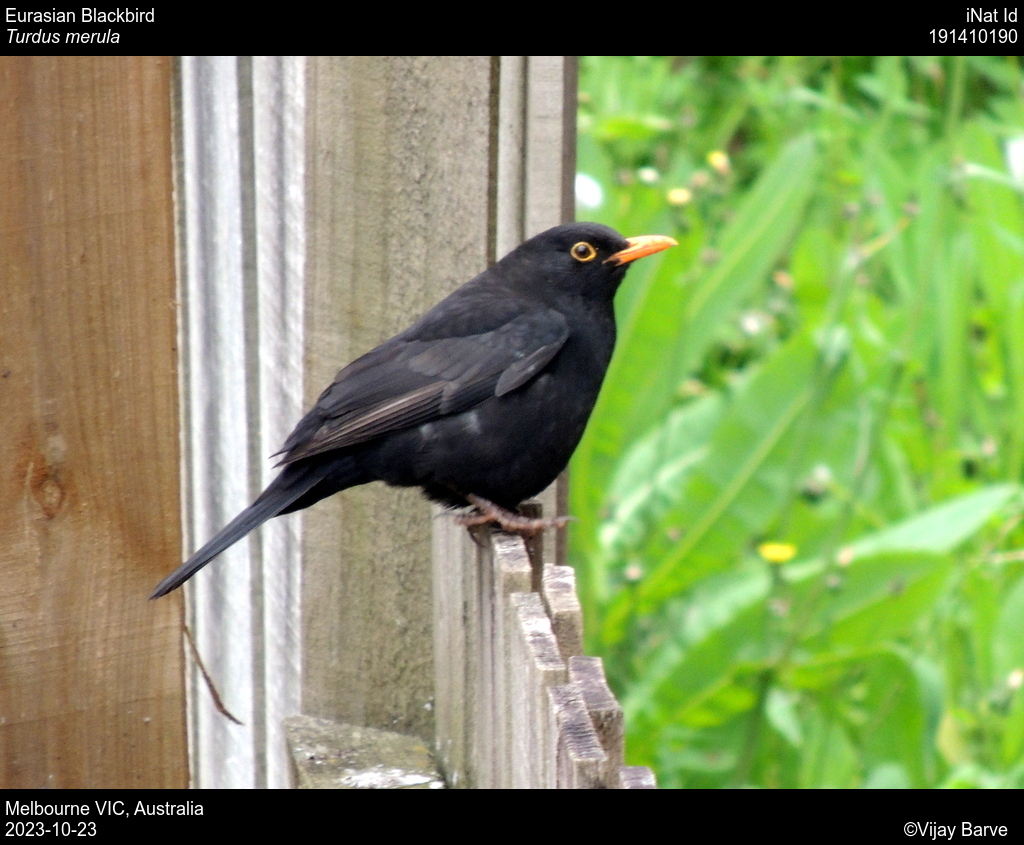
The Eurasian Blackbird (Turdus merula)


The Eurasian Blackbird (Turdus merula) also referred as Common Blackbird in Europe, a melodious songster adorned in a sleek black plumage, holds a unique place in the tapestry of Australia's avian diversity. Its presence in the land Down Under traces back to the 1800s when it was introduced to Melbourne, Victoria. From this initial introduction, the Eurasian Blackbird has embarked on an impressive expansion, successfully dispersing throughout much of southeastern Australia.


This ground-feeding bird, a common sight in gardens, parks, and open woodlands, has earned a reputation for its melodious repertoire, serenading its surroundings with a rich, flute-like song. Its diet is as diverse as its habitats, encompassing a variety of insects, earthworms, seeds, and berries. While its omnivorous nature provides sustenance, it has also led to its classification as a pest species, as it can cause damage to fruit crops.


Despite its occasional conflicts with human interests, the Eurasian Blackbird remains a captivating addition to Australia's avian landscape. Its adaptability and melodic presence have earned it a place among the country's most recognizable and well-loved birds.


In 2017, I had the privilege of encountering the Eurasian Blackbird in its native range, Israel. Amidst the vibrant greenery of the region, I was enchanted by its familiar song, a reminder of its remarkable journey across continents. The encounter served as a testament to the Eurasian Blackbird's resilience and adaptability, qualities that have facilitated its successful establishment in Australia.


The Eurasian Blackbird's presence in Australia serves as a reminder of the intricate connections that bind the natural world. Its journey across continents highlights the interconnectedness of ecosystems and the enduring impact that human actions can have on the distribution of species. While its presence has not been without challenges, the Eurasian Blackbird has undoubtedly enriched Australia's avian tapestry, adding a touch of European charm to the continent's diverse birdlife.


Wednesday, October 11, 2023

Kelp Gull (Larus dominicanus)

During my time in and around Hobart in Tasmania, I had the opportunity to observe the Kelp Gull (Larus dominicanus). These gulls are notably larger than the Silver Gulls and tend to maintain a comfortable distance from humans, in contrast to their more sociable counterparts.

I observed these Kelp Gulls engaging in various activities, including graceful flights in the sky and leisurely floating on the water. Their behavior and size make them distinct from the Silver Gulls, and it was a fascinating experience to witness their interactions in their natural habitat.

These birds are widely distributed in southern hemisphere. 


Tuesday, October 10, 2023

Meadow Argus (Junonia villida)

I have a deep appreciation for observing butterflies belonging to the Buckeyes and Pansies group, within the Genus Junonia. There are six species of this genus in India which are fairly commonly encountered.


I have so far met 13 species of Junonia across four continents and six countries.

During my time in Australia, I had the pleasure of encountering the exquisite Meadow Argus (Junonia villida), a species I had the opportunity to see in Hobart, Tasmania on multiple occasions.

These charming butterflies have a distinctive behavior of frequently resting on mud roads or roadside herbs and then taking flight only to settle nearby when disturbed. Although the Meadow Argus is known to inhabit various locations throughout Australia, I regret that the weather conditions in other places did not permit me to spot them during my travels.


Other posts about